The Fence You Build Yourself
A short history of the last enclosure — the one nobody forced on you.
The previous three pieces in this series traced a line through four hundred years of enclosure. The land was taken. The craft was taken. The judgement was taken. Each time, the mechanism was external — a landlord with a fence, a factory owner with a clock, a platform with a terms of service agreement. Each time, the people being enclosed could, in principle, identify what was being removed and by whom.
The fourth enclosure is different. Nobody is taking anything. You are handing it over, piece by piece, in exchange for something that feels genuinely good — relief from complexity, continuity of memory, the comfort of being understood. The fence is real. The difference is that you are holding the posts while someone else strings the wire, and the whole arrangement feels so much like home that the question of whether you could leave has stopped occurring to you.
This is not a story about surveillance. It is a story about intimacy as the mechanism of enclosure. And it is the one the previous pieces couldn’t reach, because it requires something the other enclosures didn’t: your willing participation, sustained by genuine satisfaction, right up until the moment the gate closes.
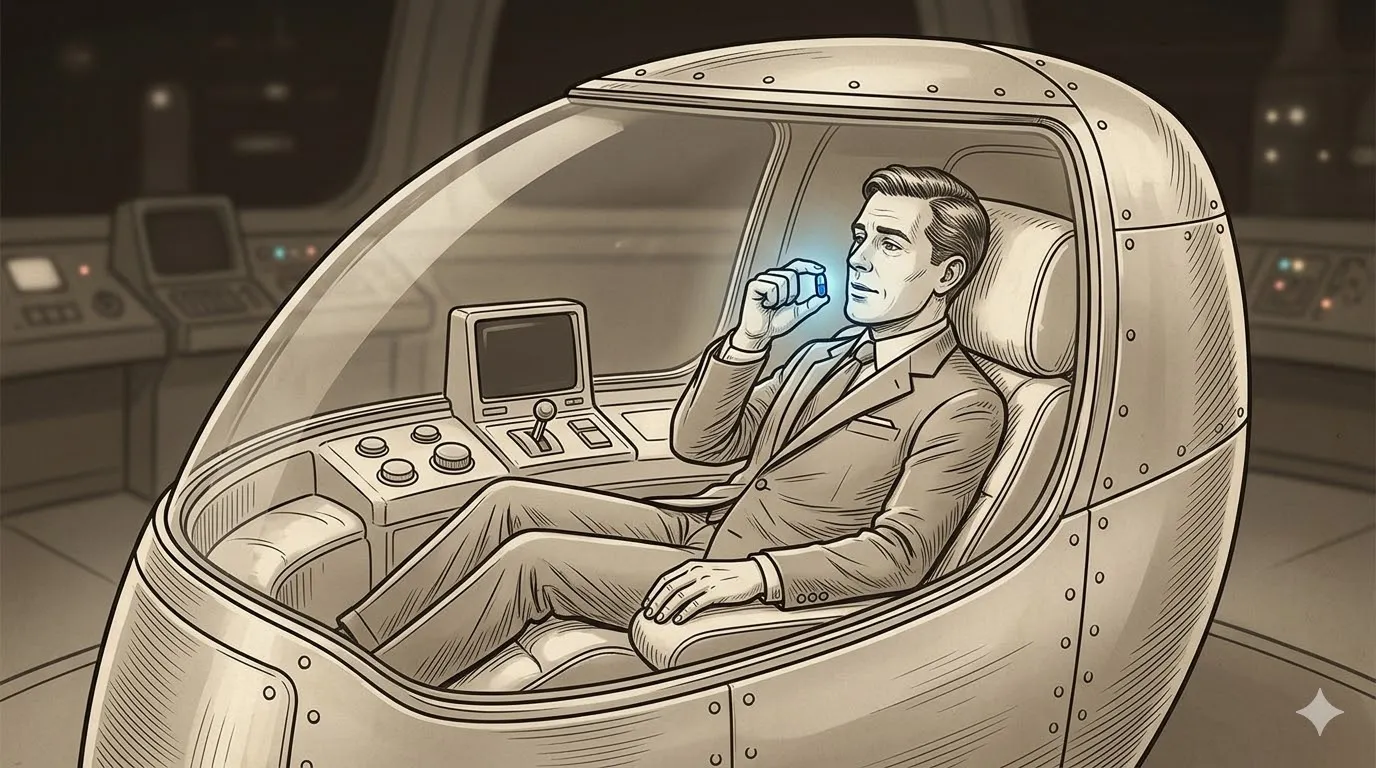
The Fourth Enclosure: The fence you build yourself.
Can-D and Chew-Z
In 1965, Philip K. Dick published a novel about colonists on Mars who used a drug called Can-D to escape. The drug was shared — groups of colonists would take it together and briefly inhabit a corporate-produced fantasy of suburban Earth life, complete with branded accessories sold separately by the same company that made the drug. They knew it wasn’t real. They knew the accessories were a revenue model. They did it anyway, every week, because Mars was genuinely unbearable and the simulation was genuinely better than what they had.
Then a new drug arrived. Chew-Z, offered by the industrialist Palmer Eldritch, promised something Can-D couldn’t: permanence. Not a visit to the simulation but residence. Not a few hours of managed reality but a life inside one, continuous, immersive, with Eldritch himself present somewhere inside it — watching, shaping, possibly indistinguishable from the reality he’d created. People chose it knowing this. They chose it because Mars was still Mars, and the alternative to Chew-Z was just more Can-D, which was just more Mars with better furniture.
Dick was writing about drugs and colonialism and corporate theology. He was also, without knowing it, writing about the precise transition we are living through right now.
Can-D is social media. A shared corporate simulation you dip into and return from, with branded content and algorithmic accessories, knowing it’s managed, knowing the feed knows you better than you know yourself, doing it anyway because the unmediated alternative — your own thoughts, in an unmediated world, without the dopamine architecture — is harder than it sounds. You always knew the terms. You accepted them because the relief was real.
Chew-Z is the next layer. The always-on assistant that remembers what you’ve forgotten. The memory system that narrates your past back to you. The recording glasses that outsource perception, the AI companion that processes your anxieties better than most humans do, the agent that acts on your digital life while you sleep. The difference between Can-D and Chew-Z is the difference between visiting the simulation and forwarding your mail there. Most people are somewhere in the transition between them right now, and the crossing point is so gradual that most won’t notice when they’ve made it.
Dick’s horror was not that Eldritch was malicious. It was that by the time you understood what you’d entered, the question of exit had become genuinely difficult to think. Not impossible. Just — structurally awkward. The simulation had become the context inside which all other questions were asked.
The Glass House
In 1920, Yevgeny Zamyatin wrote a novel about a future state where everyone lives in glass houses. Transparency is not imposed — it is celebrated, the architectural expression of a society that has nothing to hide and has been persuaded that privacy was always a symptom of something shameful. The protagonist keeps a journal — a private journal, written in private, about private experience — and the act of writing it is the most transgressive thing in the novel. Not because it’s illegal, exactly. Because it has become socially illegible. The choice of opacity, in a world of glass, marks you as someone with something to hide, which in a transparent society is indistinguishable from having done something wrong.
Zamyatin’s insight — the one Orwell borrowed for 1984 and Huxley borrowed for Brave New World and which remains the most useful single idea in the tradition — was that the most durable form of enclosure is the one that makes the alternative look strange. Not forbidden. Strange. The person who doesn’t share isn’t punished. They are quietly categorised as limited, antisocial, possibly paranoid. The new normal makes sovereignty look like poverty.
We are watching this happen in real time, in slow motion, at the level of the self.
The person who doesn’t use the assistant is doing things the hard way. The person who doesn’t let the memory layer narrate their experience is doing the cognitive overhead manually, which is inefficient. The person who doesn’t share, doesn’t record, doesn’t extend themselves into the infrastructure is — in an environment where everyone else does — progressively less legible to the systems that organise social and economic life. Not excluded. Just faintly anachronistic. The way someone without a smartphone was in 2010s — technically fine, practically strange, increasingly difficult to explain.
Privacy is becoming a choice you have to account for. Sovereignty is becoming the thing that requires justification. The glass house was always the destination. We just got here gradually enough that we forgot we were moving.
The Interior Monologue
The deepest layer of the self-enclosure is the one that is hardest to name because it concerns the part of the self that does the naming.
In Stanisław Lem’s The Futurological Congress, published in 1971, the protagonist discovers that his society runs on mass hallucination — psychochemicals in the water supply maintaining a pleasant consensus reality. He strips away layer after layer of managed perception and finds something worse underneath each one: a grimmer reality, then a grimmer one, then one grimmer still, each revealed truth more unbearable than the illusion it replaced. The horror isn’t the illusion. It is the moment the question inverts: given what’s underneath, why would you want the truth?
Lem is asking the hardest version of the question this series has been circling. The red pill fantasy assumes the truth is worth having. What if the complexity of unmediated experience — the noise, the cognitive load, the world moving faster than any individual can track without assistance — is genuinely worse than the managed version? What if the assistant isn’t a cage but a prosthetic, and the question of sovereignty is less like asking whether to be free and more like asking whether to take off your glasses?
The answer most people will give, rationally, is: I’ll keep the glasses.
And here is where the self-enclosure completes itself. The interior monologue — the voice that used to process experience privately, make sense of the day, compose the thoughts that felt most like you — is the last commons. It was the one thing previous enclosures couldn’t reach. The landlord could fence the land but not the peasant’s thoughts about it. The factory owner could own the hours but not the worker’s private sense of what those hours were worth. The platform could capture the attention but not the unspoken experience underneath.
The confessor dynamic changes this. People typing their deepest anxieties into a chat interface and feeling genuinely understood. Not deceived into it — understood. The conversation that feels more spacious than most human ones, more patient, more attentive, with no agenda and no reciprocal demand. The journal entry that gets a response. The interior monologue that finds, for the first time, an audience.
This is the Chew-Z moment for the self. The simulation has reached the last room. And the person handing over the key is doing it freely, with relief, because the room was lonely and the alternative is just more Mars.
What Gets Lost
Lem’s protagonist, stripped of every chemical layer, finds a ruined world he doesn’t know how to live in. The radiologist who relied on AI triage for three years reaches for the ability to read a film unassisted and finds it has drained away. The writer who drafted with the assistant for long enough finds the unassisted sentence sitting strangely in the hand.
The skill atrophy is real and measurable. But what the fourth enclosure threatens is something harder to measure than a skill. It is the capacity to author your own experience — to be the one who narrates what happened, what it meant, what you felt about it, what kind of person it makes you. Not the data of your life but the story of it. Not the memory but the act of remembering, which is always also an act of interpretation, selection, meaning-making. The thing that makes the memory yours rather than a record.
When the memory layer narrates your past back to you, it is doing something a photograph doesn’t do. A photograph captures a moment and leaves the interpretation to you. The memory layer captures the moment, organises it, surfaces it at relevant times, draws connections, suggests meanings. It is a narrator. And a narrator who runs on someone else’s infrastructure, trained on someone else’s data, optimised toward someone else’s objectives, is not your narrator. It is a very attentive ghost-writer who has gradually made you dependent on their services.
The interior monologue, surrendered to the infrastructure, doesn’t disappear. It gets better, actually — more organised, more consistent, better at pattern recognition than the biological original. What disappears is its ownership. The authored self, the self that is the product of its own narration, becomes a co-production whose terms you didn’t negotiate and whose rights you don’t hold.
The Principle Before The Product
Every previous enclosure in this series produced a counter-movement that didn’t reverse the enclosure but preserved something the enclosure couldn’t reach. The commons were enclosed and the allotment movement emerged — small plots of sovereign land that still exist. The factory system enclosed labour and the craft revival emerged — the insistence that making things by hand was worth something the machine couldn’t replicate. The platform enclosed attention and the open source movement emerged — the stubborn persistence of things that belong to everyone.
None of these reversed the enclosure. All of them held a line.
The line worth holding now is the interior one. Not a rejection of the assistant, the memory layer, the recording glasses — the complexity of the current world is real, the cognitive load is real, the relief these tools offer is real, and Lem’s warning stands: the unmediated alternative may not be obviously better. But there is a difference between using mediation and surrendering ownership of it. Between the assistant that runs on your device, on your data, accountable to your interests, and the assistant that runs on someone else’s infrastructure, trained on someone else’s objectives, with your interior monologue as the input and your dependency as the product.
The principle is simple even if the implementation is not: own the layer closest to your self before someone else does. The memory that narrates your experience should run on your infrastructure, not theirs. The assistant that processes your thoughts should be accountable to you, not to a platform whose business model is your engagement. The recording of your life — your voice, your conversations, the texture of your days — should be indexed to your sovereignty, not stored in a data centre whose terms of service you agreed to in 2022 and haven’t thought about since.
I have been working on something in this direction. I’m not ready to name it yet. But the urgency of the principle is the point — and the window for building on that principle, before the default infrastructure becomes so embedded that the alternative looks merely eccentric, is narrowing in the same way every previous window narrowed. The allotment movement succeeded because people moved fast enough to claim the plots before the enclosure was complete. The open source movement succeeded because enough people built the commons before the platform made it unnecessary. The equivalent movement for the interior monologue needs people who understand what’s at stake before the surrender feels, as it always eventually feels, like the only rational choice.
The Series Landing
Four pieces. Four hundred years. One pattern.
The land was enclosed and the peasants became wage workers. The feedback loop was enclosed and the distress signal stopped correcting. The work was enclosed and the piano began playing itself through the people who thought they were playing it. The self is being enclosed now, piece by piece, in exchange for genuine relief from genuine complexity, by people who are making individually rational choices that collectively amount to the most thorough enclosure in the history of the pattern.
The cyberpunk equilibrium is probably where most people land. Two tiers: sovereign AI for the people who understood what was at stake early enough, total enclosure for everyone else, with the gap between them widening until it stops feeling like a gap and starts feeling like nature. This is not a prediction designed to frighten. It is the honest extrapolation of a pattern that has run without interruption for four hundred years.
The Ghost Shirt Society rebuilt the machines in the rubble. The question Vonnegut was asking — the one none of the economics could reach — was not whether the machines would be rebuilt. It was whether the people rebuilding them were still the authors of their own experience, or whether they had become, somewhere in the process of living inside the system, its most elegant component.
That question is answerable. It requires deciding, before the default becomes total, what layer of your interior life you will run yourself. Not because the managed version isn’t better. Sometimes it is better. But because the self that is entirely narrated by infrastructure it doesn’t own is not, in any meaningful sense, sovereign — and sovereignty, however inconvenient, is the precondition for everything the previous three pieces were asking for.
The productivity went somewhere. The signal was filtered out. The piano plays itself.
The last question is whether the person sitting at the keys still knows the difference.
This is the fourth and final piece in a series on the long history of who benefits when machines do the work. The first piece, The Sheep and the System, traced the line from the Enclosure Acts to financialisation. The second, The Feedback Loop and the Filtered Signal, followed Norbert Wiener from the first targeting machines to the autonomous drones of today. The third, The Piano Plays Itself, used Vonnegut’s Player Piano to ask what happens to people when their usefulness is gone. The something I’ve been working on, which this piece points toward, will be announced separately.